14+ Aldosterone Function In Renal Tubules
Aldosterone Function In Renal Tubules. Commonly used to treat hypertension and edema caused by heart failure, cirrhosis, and nephrotic syndrome. Increases water permeability and reabsorption in the last segment of.

Kidneys play a central role in regulation of potassium homeostasis and maintenance of plasma k+levels within a narrow physiological range. Its most important physiological functions concern maintenance of sodium balance, potassium homeostasis, and excretion of hydrogen ions. Aldosterone causes sodium to be absorbed and potassium to be excreted into the lumen by principal cells.
1 14 cup of water in oz 15 minute timer with music youtube armoire porte coulissante miroir ancienne tronconneuse mc culloch
RENAL TUBULAR ACIDOSIS
Aldosterone is a type of steroid hormone that acts primarily in renal collecting ducts to stimulate reabsorption of na+ as well as secretion of k+ and h+. Kidneys play a central role in regulation of potassium homeostasis and maintenance of plasma k+levels within a narrow physiological range. The mechanisms by which aldosterone increases na(+), k(+) atpase and sodium channel activity in cortical collecting duct and distal nephron have been extensively studied. Hydrogen is excreted into the lumen, and the potassium is absorbed.

Increases water permeability and reabsorption in the last segment of. Aldosterone regulates na(+), k(+) atpase activity in human renal proximal tubule cells through mineralocorticoid receptor. Aldosterone’s primary function is to act on the late distal tubule and collecting duct of nephrons in the kidney, directly impacting sodium absorption and potassium excretion. Aldosterone upregulates epithelial sodium channels ( enacs) in the..

Aldosterone causes sodium to be absorbed and potassium to be excreted into the lumen by principal cells. Antidiuretic hormone (adh) concentration of urine is controlled by adh. Hydrogen is excreted into the lumen, and the potassium is absorbed. Recently, however, studies using isolated, perfused tubules have established with certainty that aldosterone can regulate the transepithelial transport function of native renal.

By stimulating sodium absorption by the sodium transporter in the cortical collecting tubule, aldosterone also indirectly promotes hydrogen excretion by type a intercalated cells, through creating a negative lumen potential after sodium is resorbed. Kidneys play a central role in regulation of potassium homeostasis and maintenance of plasma k+levels within a narrow physiological range. Hydrogen is excreted into the lumen,.
Aldosterone regulates na(+), k(+) atpase activity in human renal proximal tubule cells through mineralocorticoid receptor. It promotes the secretion of k+ in the tubular lumen. Antidiuretic hormone (adh) concentration of urine is controlled by adh. This review presents a concise update of nongenomic effects of aldosterone on the mammalian renal tubule. Recently, however, studies using isolated, perfused tubules have established.
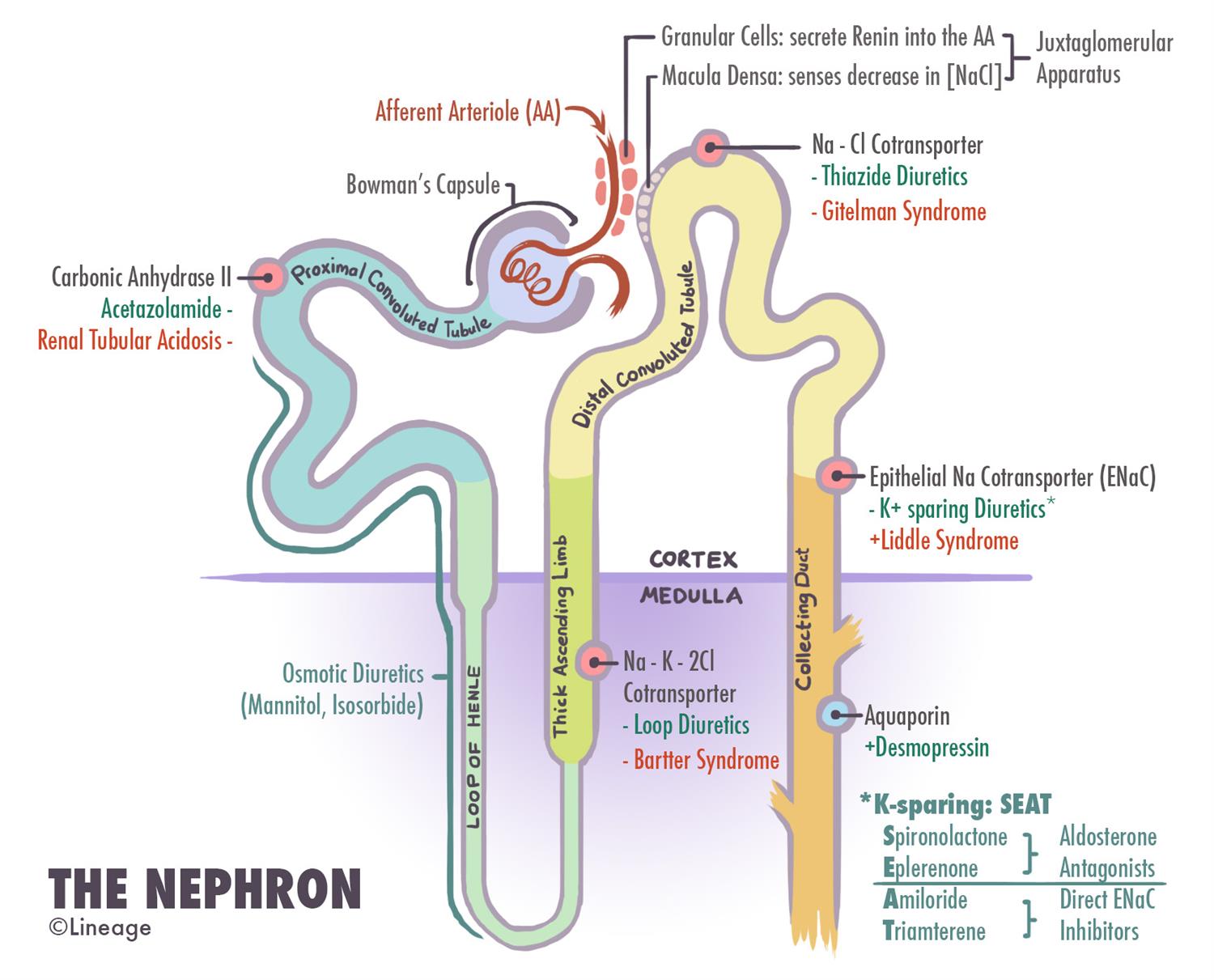
Aldosterone is a type of steroid hormone that acts primarily in renal collecting ducts to stimulate reabsorption of na+ as well as secretion of k+ and h+. Hydrogen is excreted into the lumen, and the potassium is absorbed. Action of aldosterone on renal collecting tubule cells. Aldosterone upregulates epithelial sodium channels ( enacs) in the. It binds with intracellular receptors.

Commonly used to treat hypertension and edema caused by heart failure, cirrhosis, and nephrotic syndrome. It promotes the secretion of k+ in the tubular lumen. Aldosterone tends to promote na + and water retention, and lower plasma k + concentration by the following mechanisms: By stimulating sodium absorption by the sodium transporter in the cortical collecting tubule, aldosterone also indirectly.

Aldosterone’s primary function is to act on the late distal tubule and collecting duct of nephrons in the kidney, directly impacting sodium absorption and potassium excretion. Hydrogen is excreted into the lumen, and the potassium is absorbed. Aldosterone tends to promote na + and water retention, and lower plasma k + concentration by the following mechanisms: Antidiuretic hormone (adh) concentration.

Aldosterone causes sodium to be absorbed and potassium to be excreted into the lumen by principal cells. The activated receptor then stimulates the production of ion channels in renal tubular cells, which increases the reabsorption of sodium in the blood and increases the excretion of potassium in the urine. By stimulating sodium absorption by the sodium transporter in the cortical.